A Guide to Fixed & Variable Displacement Auto AC Compressors
2025-12-18
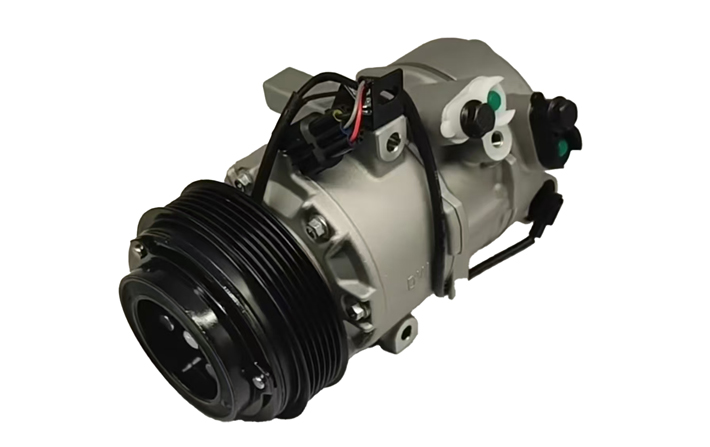
Within an automotive air conditioning system, the compressor is the core component that drives the refrigeration cycle. Its primary function is to compress low-temperature, low-pressure gaseous refrigerant into a high-temperature, high-pressure state, enabling it to release heat in the condenser. The technical type of compressor directly impacts the system's efficiency, energy consumption, and cabin comfort. Currently, the main categories are Fixed Displacement Compressors and Variable Displacement Compressors. Understanding the distinction between them is essential for selecting the most appropriate and efficient replacement part for a vehicle.
I. Working Principles.
1. Fixed Displacement Compressor.
Its internal design dictates that the volume of refrigerant it compresses per revolution(i.e., its displacement) is constant. It operates in an "on-off cycling" mode: when the cabin temperature reaches the set point, an electromagnetic clutch disengages the compressor, causing it to stop. When the temperature rises again, the clutch re-engages, and the compressor operates at its full displacement. Cooling output is regulated solely by alternating cycles of operation and stoppage.
2. Variable Displacement Compressor.
This type of compressor can automatically and continuously adjust its working displacement based on the actual cooling demand of the A/C system.It typically contains an internal control valve that senses system pressure changes and mechanically adjusts parameters (such as the swash plate angle or the engagement of scrolls) to alter the piston stroke or effective working volume. This changes the refrigerant output, allowing for stepless modulation. This process often allows the compressor to run continuously without disengagement.
II. Characteristics and Applicability of Fixed Displacement Compressors.
Advantages: The structure is relatively simple, the manufacturing technology is mature, leading to generally lower production and replacement costs. Their failure modes are more straightforward, making diagnosis and repair easier. Their reliability is well-proven over long-term use.
Disadvantages: The "all-on or all-off" operation can cause slight fluctuations in cabin temperature. The cyclical engagement and disengagement can create a perceptible variation in engine load, potentially affecting driving smoothness. From an energy efficiency standpoint, operating at full load whenever engaged is less economical during periods of partial cooling demand.
Vehicle Applications: Primarily and widely used in economy-class cars, older model vehicles, and commercial vehicles where cost control is critical, meeting basic, reliable cooling needs.
III. Characteristics and Applicability of Variable Displacement Compressors.
Advantages: They provide continuous, smooth cooling output, resulting in more precise and stable cabin temperature control, significantly enhancing comfort. The ability to match output to demand reduces unnecessary energy consumption, helping to lower overall vehicle fuel consumption. The smoother load variation is also gentler on engine operation.
Disadvantages: The internal structure is more complex, involving more precision components (e.g., the control valve), leading to higher initial manufacturing costs. Consequently, fault diagnosis and repair require more specialized knowledge and equipment, increasing maintenance complexity and cost.
Vehicle Applications: These have become the standard configuration for the vast majority of mid-to-high-end sedans, SUVs, luxury brand vehicles, and new model passenger cars. They are particularly well-suited for vehicles equipped with automatic climate control systems and better meet the efficiency requirements for auxiliary systems in hybrid and other fuel-efficient vehicles.
Summary
Fixed displacement compressors regulate cooling through on-off cycling, with advantages in cost and reliability. Variable displacement compressors achieve smooth cooling through stepless modulation, with core value in comfort and efficiency. When selecting a replacement part, adhering to the vehicle's original design is paramount. For vehicles prioritizing economy and practicality, a fixed displacement compressor is a reliable choice. For vehicles designed for comfort and modern energy-saving technology, a variable displacement compressor matching the original specifications is the optimal solution to ensure overall system performance.