How a Water Pump Works: How the Impeller Circulates Coolant.
2025-12-05
The proper operation of a car engine relies on the cooling system's ability to continuously remove excess heat. This system functions like a closed-loop "circulatory" network, with its flow entirely dependent on the water pump. By rotating its core component—the impeller—the water pump converts the engine's mechanical energy into the hydraulic energy needed to circulate the coolant. This article clearly explains how it works.
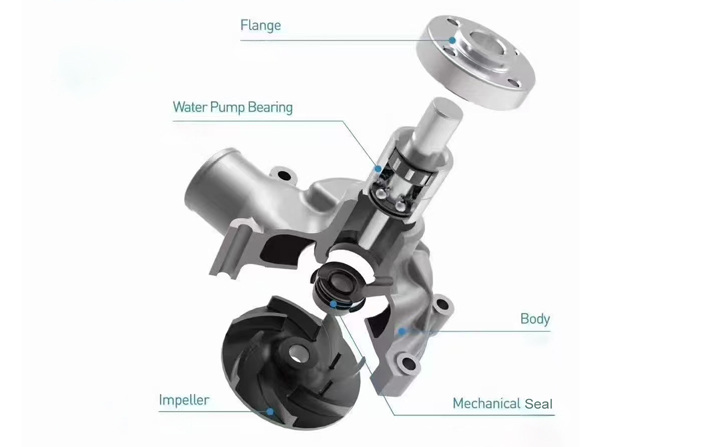
The Core Function of the Water Pump: Providing Circulation Power.
The water pump is the forced circulation power source for the engine cooling system. It is typically driven by the engine crankshaft via a belt. Its core task is not cooling itself, but rather providing the pressure and flow rate required for the coolant to move, enabling it to:
Flow from the radiator into the hot engine block and cylinder head to absorb heat.
Transport the heated coolant back to the radiator for cooling.
If the water pump fails, coolant circulation stops immediately. Regardless of how efficient other cooling components are, the engine will overheat rapidly. Therefore, the water pump is the prerequisite and foundation for the entire system's operation.
Core Mechanism: The Centrifugal Pump Principle of the Impeller.
The heart of the water pump's power generation is its internal impeller. This is a rotating disc with several curved blades. Its operation strictly follows the centrifugal pump principle, converting rotational mechanical energy into fluid pressure energy. The process occurs in three steps:
1. Creating Low Pressure and Drawing in Fluid: Driven by the engine, the impeller rotates at high speed. The fluid at its center is thrown outward by centrifugal force, creating a low-pressure zone at the impeller's inlet. This low pressure continuously "draws in" coolant returning from the radiator.
2. Imparting Energy, Acceleration, and Pressure Increase: Once the coolant enters the channels between the blades, it is carried along by the rotating impeller. Under strong centrifugal force, the liquid is flung from the center to the outer edge at high speed, significantly increasing its kinetic energy (velocity) and pressure energy.
3. Converting Energy and Delivering Stable Output: The high-velocity fluid thrown from the impeller enters the pump housing's volute. The volute's gradually expanding passage efficiently converts the fluid's kinetic energy into stable static pressure energy. Finally, the coolant is pumped into the engine's water passages with sufficient pressure.
By rotating, the impeller "sucks" at the center and "flings" at the periphery, utilizing centrifugal force to transform the engine's rotational force into the hydraulic pressure that drives coolant circulation.
Synergy with System Components: Its Foundational Role as the Power Source.
As the system's power core, the proper operation of the water pump is the foundation for the effectiveness of all heat exchange components. Its relationship with key cooling system parts is as follows:
Relationship with the Thermostat: The water pump provides the circulation power, while the thermostat acts like a "control valve," directing the flow path (a "small circuit" for rapid warm-up and a "large circuit" for cooling).
Relationship with Various Radiators/Coolers: Whether it's the main engine radiator, the air conditioning system's condenser, the turbocharging system's intercooler, or the oil cooler, their efficient heat dissipation relies on the stable coolant flow rate and velocity provided by the water pump.
Relationship with the Cooling Fan: The radiator fan enhances heat dissipation by moving air externally, while the water pump ensures an adequate volume of hot coolant is delivered to the radiator's interior. The two work in concert to complete the heat exchange process.
Summary
The water pump, through the centrifugal force generated by its rotating impeller, is the sole power source driving the entire coolant circulation. It is the fundamental guarantee for the proper operation of all components reliant on coolant flow, including the engine radiator, air conditioning condenser, and heating system. Therefore, maintaining the water pump in good condition is key to ensuring the stable operation of the engine and the entire thermal management system.